
First-Time Home Buyers: The Complete Guide to the FHSA (and Why You Should Open One Before December 31).
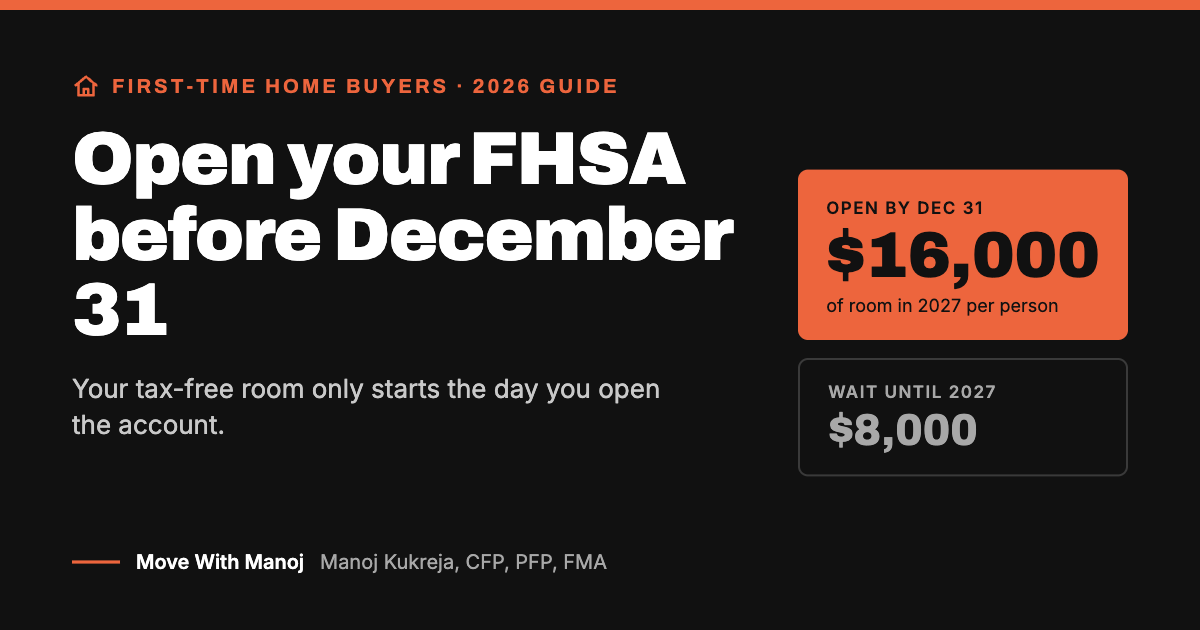
If you plan to buy your first home in the next few years, the single most valuable thing you can do this year costs nothing: open a First Home Savings Account (FHSA) before December 31.
I've sat across the table from a lot of first-time buyers. The ones who come out ahead aren't always the ones who earn the most. They're the ones who started early and used the government programs in the right order.
The FHSA is the best of those programs, and it has one rule that catches almost everyone: your contribution room doesn't exist until you open the account. Every year you wait is room you can never get back.
In this guide, I'll walk you through exactly how the FHSA works, why timing matters so much, and how to stack it with every other first-time buyer program in Ontario. No jargon. Just what you need to know to keep more of your money.
What is an FHSA?
The FHSA is a registered savings account built only for first-time home buyers. It launched in April 2023, and it's the only account in Canada that gives you a tax break on the way in and on the way out.
Think of it as an RRSP and a TFSA combined:
- Money in = tax refund. Contributions are tax-deductible, just like an RRSP.
- Growth = tax-free. Interest, dividends and gains inside the account aren't taxed.
- Money out = tax-free. Withdraw it to buy your first home and you pay no tax. You never pay it back.
| Feature | FHSA | RRSP | TFSA |
|---|---|---|---|
| Contributions tax-deductible | Yes | Yes | No |
| Tax-free withdrawal for a home | Yes | Only via Home Buyers' Plan | Yes |
| Must repay what you withdraw | No | Yes, over 15 years | No |
| Annual limit (2026) | $8,000 | 18% of income, up to $33,810 | $7,000 |
| Lifetime limit | $40,000 | None | None |
The key numbers to remember: $8,000 a year, up to $40,000 in total. Buying with a partner? You can each open your own FHSA, which means up to $80,000 combined for the same home.
Short on time?
Skip the reading. In a free 1-on-1 session, I'll show you exactly how much you could save as a first-time buyer, and what to do before December 31.
Who qualifies?
You can open an FHSA if you are:
- A resident of Canada
- At least 18 (and under 71 in the year you open it)
- A first-time home buyer. For the FHSA, that means you haven't lived in a home that you, or your spouse or common-law partner, owned at any time in the year you open the account or the four calendar years before it.
That last point surprises people in a good way. "First-time" doesn't have to mean "never." If you owned a home years ago but haven't lived in one you or your partner owned for the past four calendar years, you may qualify again.
A few more things worth knowing:
- Your co-buyer doesn't have to qualify. If you're buying with someone who isn't a first-time buyer, you can still use your own FHSA. You just can't use theirs.
- An investment property you never lived in doesn't count against you. The test is about homes you occupied as your principal residence.
- Your partner's home can count against you. If your spouse owns the home you live in, you won't qualify to open one. Ask me about your situation before assuming either way.
Why you need to open it now, even with $0
Here's the rule that matters most: FHSA contribution room only starts the year you open the account. Unlike a TFSA, you don't get credit for the years before that.
You get $8,000 of new room each year the account is open. If you don't use it, up to $8,000 carries forward to the next year. That means opening an empty account this year still banks $8,000 of room you can use later.
Here's what that looks like for someone planning to buy in 2027:
| Scenario | Most you can contribute by end of 2027 | For a couple |
|---|---|---|
| Open in 2026, contribute $0 this year | $16,000 (all in 2027) | $32,000 |
| Open in 2026, contribute $8,000 this year | $16,000 ($8,000 + $8,000) | $32,000 |
| Wait and open in 2027 | $8,000 | $16,000 |
Same account, same effort, half the room. The only difference is when you opened it.
It matters over the long run too. It takes five years of room to reach the $40,000 lifetime limit. Open in 2026 and you can max it out by 2030. Wait until 2028 and you can't get there until 2032.
One more thing about timing: FHSA contributions run on the calendar year. There's no 60-day grace period like the RRSP. If you want room or a deduction for 2026, the deadline is December 31.
How the tax refund works
Every dollar you put into your FHSA reduces your taxable income. The higher your tax bracket, the bigger your refund.
Here's a rough idea of what an $8,000 contribution could put back in your pocket in Ontario:
| Your income (approx.) | Approx. marginal tax rate | Approx. refund on $8,000 |
|---|---|---|
| $60,000 | ~30% | ~$2,400 |
| $100,000 | ~43% | ~$3,500 |
These are estimates. Your actual refund depends on your full tax picture.
Now put the whole cycle together. Contribute $8,000 a year for five years, and you've saved $40,000 for your down payment. Along the way you could get back roughly $12,000 to $17,500 in refunds. Plus any growth inside the account, and you withdraw all of it tax-free.
Two strategies most people don't know about
1. You don't have to claim the deduction right away. You can contribute now and save the deduction for a future year when your income is higher. A bigger income usually means a bigger refund for the same contribution. Unused deductions carry forward with no time limit. One catch: contributions made after your first home withdrawal can't be deducted. That's one of the first things I look at with clients.
2. Family can help you fill it. Parents and other relatives can gift you money to put into your FHSA. You still get the deduction, and the growth is still tax-free.
Using your FHSA when you buy
When you find your home, you take the money out with a "qualifying withdrawal." Done right, it's completely tax-free and you never repay it. To qualify, you need to:
- ✓Still be a first-time buyer when you withdraw. You can withdraw up to 30 days after moving into your new home.
- ✓Be a resident of Canada from your first withdrawal until you buy.
- ✓Have a written agreement (an accepted offer) to buy or build a home in Canada, closing before October 1 of the year after your withdrawal.
- ✓Plan to live in it as your principal residence within one year of buying or building it.
- ✓Fill out Form RC725 and give it to your FHSA provider.
You don't have to take it all out at once. And you can use the FHSA and the RRSP Home Buyers' Plan for the same home, which is where things get really powerful.
The FHSA is just the start: stacking every program
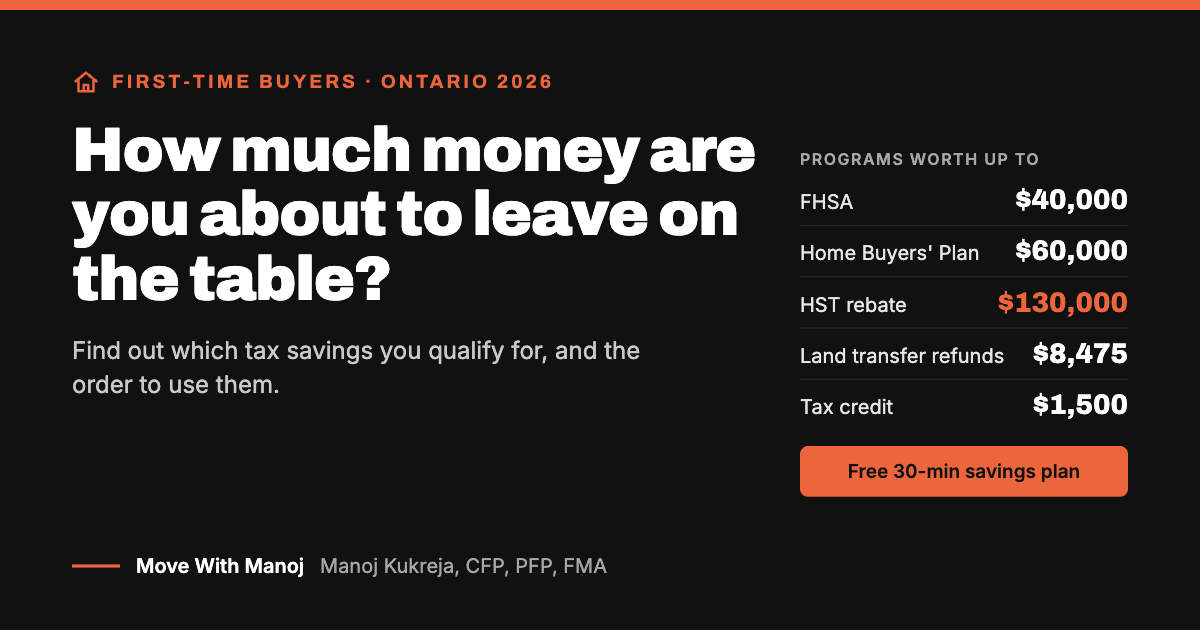
First-time buyers in Ontario can combine several programs on a single purchase. Here's the full toolkit:
| Program | What it does | Up to |
|---|---|---|
| FHSA | Tax-deductible, tax-free down payment savings. Never repaid. | $40,000 per person |
| RRSP Home Buyers' Plan (HBP) | Borrow from your RRSP tax-free. Repay over 15 years. | $60,000 per person |
| First-time buyer HST rebate | Full 13% HST back on a new home up to $1M | $130,000 |
| Ontario land transfer tax refund | Refund on the provincial land transfer tax | $4,000 |
| Toronto land transfer tax rebate | Extra rebate if you buy in the City of Toronto | $4,475 |
| Home Buyers' Tax Credit | Federal tax credit on your return | $1,500 |
Put the FHSA and Home Buyers' Plan together and you could have up to $100,000 per person, or $200,000 for a couple, toward your down payment.
A closer look at the Home Buyers' Plan
The HBP lets you take up to $60,000 out of your RRSP without tax. Unlike the FHSA, it's a loan to yourself. You repay at least 1/15 of it each year for 15 years, and repayments start the second year after you withdraw. Miss a payment and that amount is added to your taxable income.
One rule trips people up: money has to sit in your RRSP for at least 90 days before you withdraw it under the HBP. Otherwise you lose the deduction on that contribution. If you're closing in spring, plan your RRSP contributions now.
A closer look at the HST rebate
This one only applies to new or substantially renovated homes, not resales. For a first-time buyer, it can take the full 13% HST off a new home priced up to $1 million. On a $750,000 new build, that's up to $97,500 back. If you're open to new construction, this can be the single biggest saving in the table.
The order to use them: a simple game plan
Having the tools is one thing. Using them in the right order is where the real savings are. Here's the general approach I walk most first-time buyers through:
- Open your FHSA now. Do it before December 31, even with $0. This starts your contribution room.
- Fill your FHSA first. It's the only account you never repay, so every dollar here works hardest for you.
- Decide when to claim the deduction. If your income is about to rise, holding the deduction for a later year could mean a bigger refund.
- Use your RRSP for the Home Buyers' Plan next. Contribute at least 90 days before you plan to withdraw.
- Keep your TFSA for closing costs and a cushion. Lawyer fees, moving and the first few months of ownership add up.
- Look at new construction for the HST rebate. If a new build fits your plans, it could save you tens of thousands.
- Claim your land transfer tax refund and tax credit at closing. Your lawyer handles the land transfer refund. The tax credit goes on your return.
Every situation is different. Your income, your timeline, whether you're buying alone or with a partner, and what's already in your RRSP all change the best order. That's exactly what I map out in a strategy session.
6 common FHSA mistakes to avoid
- ✗Waiting to open it until you have money to put in. Room only starts when the account opens. Open it empty if you have to.
- ✗Missing the December 31 deadline. There's no 60-day extension like the RRSP.
- ✗Over-contributing. Carry-forward is capped at $8,000, so the most you can put in any one year is $16,000. Going over costs a 1% penalty per month on the excess.
- ✗Assuming you need to repay it. You don't. That's the FHSA's biggest advantage over the Home Buyers' Plan.
- ✗Depositing into your RRSP right before closing. HBP money needs to sit in your RRSP for 90 days first.
- ✗Forgetting the time limit. An FHSA can stay open for a maximum of 15 years. It must also close by the end of the year you turn 71, or the year after your first qualifying withdrawal.
What if you never buy?
This is the question I hear most, and the answer is why I tell almost every eligible buyer to open one.
If your plans change, you can transfer your FHSA into your RRSP or RRIF tax-free. The transfer doesn't use up your regular RRSP contribution room. In other words, you got the tax deductions along the way, the money grew tax-free, and it becomes retirement savings on top of what you could normally put away.
You can also simply withdraw the money, but a non-qualifying withdrawal is added to your taxable income. The RRSP transfer is usually the better route.
The worst case is extra retirement savings. The best case is a bigger down payment. There's very little downside to opening one.
Frequently asked questions
Where do I open an FHSA?
Most Canadian banks, credit unions and online brokerages offer them. Opening one usually takes about 15 minutes online.
Can I have more than one FHSA?
Yes, but the $8,000 annual and $40,000 lifetime limits apply across all of them combined.
What can I invest in?
The same types of investments as an RRSP or TFSA, such as savings deposits, GICs, ETFs and stocks. If you're buying in the next year or two, lower-risk options usually make more sense.
Can I move money from my RRSP into my FHSA?
Yes, but it counts toward your $8,000 annual room and you don't get a new deduction for it, since you already got one when it went into your RRSP.
Can I use both the FHSA and the Home Buyers' Plan on the same home?
Yes. That's how a single buyer can reach up to $100,000, or a couple up to $200,000.
My partner already owns a home. Can I still open one?
If you live in a home your spouse or common-law partner owns, you generally won't qualify. Every situation has details, so let's talk it through before you decide.
Is the HST rebate available on resale homes?
No. It only applies to new or substantially renovated homes. Resale buyers still get the land transfer tax refunds, the tax credit, the FHSA and the HBP.
Why work with me on this?
Most agents can help you find a home. I can also help you pay for it smarter.
Before I got into real estate in 2013, I spent a decade at major Canadian financial institutions. I'm a Certified Financial Planner (CFP), I hold the PFP and FMA designations, and I've been recognized among Canada's top ten financial planners. Since then, I've helped over 100 families across the GTA buy and sell homes.
That background changes how I work with first-time buyers. Before we look at a single listing, I look at your whole picture: how much you can save, which accounts to use first, when to claim your deductions, and how to keep more of your money at closing.
Book your free first-time buyer strategy session
In one conversation, we'll map out:
✓ How much you could save using the FHSA, HBP and every rebate you qualify for
✓ The right order to use them for your income and timeline
✓ What to do before December 31 so you don't lose a year of room
No cost, no pressure. Prefer to talk? Call or text (647) 576-2100.
— Manoj Kukreja, CFP, PFP, FMA
This article is general information, not personalized tax, legal or financial advice. Program rules, limits and eligibility can change, and the right strategy depends on your situation. Tax refund figures are approximate. Figures reflect 2026 limits. Manoj Kukreja, Century 21 People's Choice Realty Inc., Brokerage. Not intended to solicit buyers or sellers currently under contract with a brokerage.
Sources
- Wealthsimple – FHSA FAQs
- Canadian Money Help – FHSA contribution limits 2026
- Canadian Money Help – Home Buyers' Plan limit 2026
- CRA Form RC725 – FHSA qualifying withdrawal
- BMO Nesbitt Burns – First Home Savings Account
- Sun Life – FHSA quick reference guide
- TRREB – 2026 HST New Home Buyer Rebate
- TRREB – RRSP Home Buyers' Plan
- Pegasus Lending – First-time buyer incentives 2026

Comments