
Mississauga vs Brampton: Which City Should You Live In?
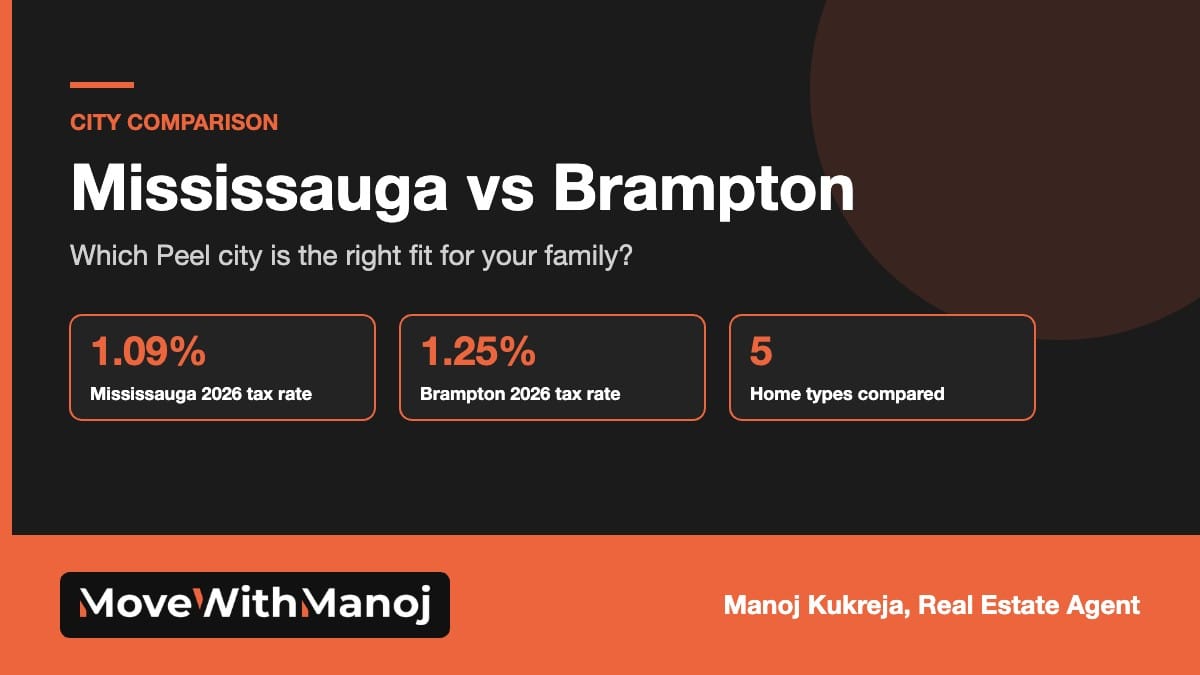

Mississauga and Brampton are the two big cities of Peel Region, they share a long border, and a lot of families I work with are torn between them. Usually the conversation goes something like this: "We love the space we can get in Brampton, but is Mississauga worth paying more for?"
There's no single right answer, but there is a right answer for your family. I've helped buyers and sellers in both cities for over a decade, so here's how I'd compare them: lifestyle first, then commuting, schools, the homes you'll find, prices by home type and property taxes.
Already looking? Browse homes for sale in Mississauga or homes for sale in Brampton.
In this guide
Mississauga vs Brampton at a glance
| Mississauga | Brampton | |
|---|---|---|
| Feel | Established city with a lakefront and a downtown core | Fast-growing, family-focused, newer suburbs |
| Population (2021 Census) | 717,961 | 656,480 |
| Best for | Lake, condos, airport and highway access | More house for your money, newer homes |
| Homes | Big condo market plus every type of house | Mostly detached, semis and townhomes |
| 2026 residential tax rate | 1.087901% | 1.253381% |
| GO train lines | Lakeshore West and Milton | Kitchener |
Lifestyle: what living in each feels like
Mississauga has had a few decades longer to grow up. It has the lake, with Port Credit's waterfront, marinas and trails; a real downtown around Square One and Celebration Square; and older, leafy neighbourhoods like Mineola, Lorne Park and Streetsville alongside newer family areas like Churchill Meadows. If you like having a lot of options for dining, shopping and things to do, Mississauga delivers.
Brampton is younger and growing fast, and it's built around families. Much of the city has been built in the last 25 years, so you'll find big new subdivisions, newer schools and community centres, and lots of parks. It has wonderful green spaces too: Chinguacousy Park, Gage Park downtown, and Heart Lake Conservation Area and Professor's Lake for summer days. Downtown Brampton has the Rose Theatre and a growing arts scene.
Both cities are very diverse, with large South Asian, Caribbean, Filipino, Portuguese and many other communities. In Brampton especially, you'll find a strong sense of community, big multi-generational households and some of the best food in the GTA.
Where they are
Brampton sits directly north of Mississauga. The two cities meet roughly around Highway 407, so north Mississauga neighbourhoods like Meadowvale Village and East Credit are only a few minutes from south Brampton.
Mississauga (south) and Brampton (north), Ontario. Open in Google Maps


Commuting and getting around
- GO Train: Mississauga has the Lakeshore West line (all-day, two-way service) plus the Milton line. Brampton is on the Kitchener line, with stations at Bramalea, downtown Brampton and Mount Pleasant. Check GO Transit for current schedules.
- Highways: Mississauga has the QEW, 401, 403, 410 and 427 close by. Brampton has the 410 running through the middle and the 407 along its southern edge, while the 401 is a short drive south. For many Brampton commuters, getting to the 401 is the slowest part of the trip.
- Airport: Pearson is in Mississauga, but it's also close to east Brampton.
- Local transit: Mississauga has MiWay and its Transitway; Brampton Transit runs the Züm rapid bus routes. The Hazel McCallion Line LRT along Hurontario, connecting the two cities, is still under construction.
- Hospitals: Mississauga has Credit Valley and Mississauga Hospital; Brampton has Brampton Civic Hospital and Peel Memorial.
Schools
Both cities are served by the same two boards, the Peel District School Board and the Dufferin-Peel Catholic District School Board, so programs like French Immersion, IB and regional specialty programs are available in both. School results vary much more by neighbourhood than by city.
See the Fraser Institute rankings for each:
- Best high schools in Mississauga and best elementary schools in Mississauga
- Best high schools in Brampton
Always confirm the school boundary for the exact address with the board before you buy.
Homes and prices by home type
This is where Brampton wins for a lot of families. In general, your money buys more house in Brampton: newer homes, more bedrooms, often a double garage, and many homes with a finished basement or a legal second unit that can help with the mortgage.
Mississauga's advantage is range. It has a large condo market, older neighbourhoods with big lots, lakefront areas and newer subdivisions, so there's something at almost every price point.
Here's a ballpark of typical prices by home type in each city, based on my own Mississauga and Brampton market pages in fall 2026. Prices change every month, so use this to compare the cities, then check the live numbers on my Mississauga house prices and Brampton house prices pages.
| Type of home | Mississauga | Brampton |
|---|---|---|
| Detached | ~$1.33M | ~$940K |
| Semi-detached | ~$910K | ~$750K |
| Freehold townhouse | ~$880K | ~$720K |
| Condo townhouse | ~$680K | ~$570K |
| Condo apartment | ~$505K | ~$370K |
The gap is biggest for detached homes, where Mississauga typically costs several hundred thousand dollars more. That's why so many of my clients who want a detached house with space for parents or grandparents end up in Brampton, while buyers who want a condo, the lake or a shorter commute lean toward Mississauga.
Curious what income you'd need? See my guide on how much income you need to buy a house by home type.
Property taxes
Brampton's residential tax rate is higher than Mississauga's. For 2026, the total residential rate (city, Region of Peel and education combined) is 1.253381% in Brampton and 1.087901% in Mississauga, according to the Region of Peel's total 2026 tax rates.
Remember that the rate is applied to your home's MPAC assessed value, not the price you pay. Because Brampton homes generally cost less, the actual bill on a similar home can be closer than the rates suggest. Always look at the current tax bill on any home you're considering.
Neither city has a municipal land transfer tax, so you'll only pay the Ontario land transfer tax when you buy. My land transfer tax guide explains how it works and the first-time buyer rebate.
Car and home insurance
Insurance is the cost most buyers forget to compare, and it's one of the biggest differences between these two cities. Brampton has the most expensive car insurance in Ontario. In MyChoice's 2026 Ontario overview, Brampton drivers paid an average of $3,471 a year, compared with $2,494 in Mississauga. That's about 39% more for the same coverage.
Other data shows a smaller gap but the same story. MyChoice's 2026 quote data puts Brampton's median premium at $4,210, about 14% more than Mississauga's $3,683. Either way, a two-car family in Brampton can easily pay $1,000 to $2,000 more a year, and your postal code, driving record and car all change the number.
Home insurance is a different story. The difference between the two cities is small, and on average Brampton can even come out a little lower: Rates.ca's 2025 data shows $1,352 a year in Brampton and $1,470 in Mississauga. Your home's age, size, rebuild cost and flood risk matter far more than the city.
My advice: get car and home insurance quotes for the exact address before you make an offer, the same way you'd check the property tax bill. Add that number to your monthly budget when you compare homes in the two cities.
Which one is right for you?
Mississauga may suit you better if:
- You want to be near the lake, the airport or the 401/403/QEW.
- You're buying a condo or want lots of choice at different price points.
- You commute downtown and want the all-day Lakeshore West GO line.
Brampton may suit you better if:
- You want the most space for your budget, or a newer home.
- You're a multi-generational family, or want a basement unit to help with the mortgage.
- Your work is in Brampton, Vaughan, Caledon or along the 410 corridor.
To dig deeper, read my Mississauga living guide, my Brampton living guide, and my guides to the best neighbourhoods in Mississauga and the best neighbourhoods in Brampton.
Frequently asked questions
Is Brampton cheaper than Mississauga?
Generally, yes. Brampton prices are lower across every home type, with the biggest difference for detached homes, where Mississauga typically costs several hundred thousand dollars more.
Are property taxes higher in Brampton or Mississauga?
Brampton's rate is higher: the 2026 total residential rate is 1.253381% in Brampton and 1.087901% in Mississauga (Region of Peel). The actual bill depends on the home's MPAC assessed value.
Is Mississauga bigger than Brampton?
Yes, slightly. The 2021 Census counted 717,961 people in Mississauga and 656,480 in Brampton, though Brampton has been growing faster.
Do Mississauga and Brampton have the same school boards?
Yes. Both are served by the Peel District School Board and the Dufferin-Peel Catholic District School Board.
Which is better for commuting, Mississauga or Brampton?
Mississauga has more highway options (QEW, 401, 403, 410, 427), the all-day Lakeshore West GO line and Pearson Airport. Brampton has the Kitchener GO line, the 410 and the 407, and the 401 is a short drive south.
Is there a municipal land transfer tax in Mississauga or Brampton?
No. Only the City of Toronto has a municipal land transfer tax, so buyers in Mississauga and Brampton pay the Ontario land transfer tax only.
Already own a home in Peel?
If you're selling in one city to buy in the other, your current home's value sets your budget. It's worth knowing that number before you start shopping.
Moving between Mississauga and Brampton?
Your current home is usually your biggest down payment. Find out what it's worth today, free and with no obligation.
Get my free home evaluation →Have questions about either city? Call my office at 647-576-2100.

Comments